At a glance
Freed
- Best for
- Solo outpatient psychiatrist or PMHNP who wants to buy today: Starter is $39/mo with a 7-day trial, and the BAA is part of the Platform Terms on every plan.
- Skip if
- Practice on Epic or athenahealth that needs in-chart writeback: no Epic or other named native integration is publicly documented.
- Entry price
- Starter $39/mo; 7-day trial (source)
- BAA
- Yes. BAA in the Platform Terms on every plan
- Last checked
- 2026-11-06
How this score works: Freed 76/100
Five categories, 0 to 20 points each, from public vendor documentation as of 2026-11-06. Unknown items score 0.
Prices published, free plan or trial, entry price at or under $100/mo, contract terms disclosed (5 points each).
Notes delivered into the EHR, Epic integration, another named native integration, in-chart or two-way workflow (5 each).
BAA publicly documented, SOC 2 Type 2, retention and deletion controls, model training policy (5 each; 3 if de-identified data only).
Psychiatry or behavioral health support, audio deleted by default, short note retention you set, 42 CFR Part 2 controls (5 each).
Mobile capture, telehealth capture, coding help, patient instructions or letters (5 each).
BAA gate: ranking requires a publicly documented BAA. That gate decides whether a vendor is ranked; it does not add or remove points. (Separately, a documented BAA is one 5-point item under Privacy.) Freed is ranked #3 among vendors with a documented BAA.
Visit Freed pricing (source)May earn a referral fee. No paid placement.
Heidi
- Best for
- Solo psychiatrist on athenahealth: a native athenahealth integration with schedule sync and structured writeback is listed.
- Skip if
- 42 CFR Part 2 program: Part 2 specific controls are not publicly described.
- Entry price
- Free plan; Clinician $150/mo or $110/mo yearly; Max seat $409/mo or $299/mo yearly; Teams custom (source)
- BAA
- Yes. BAA available to every covered entity
- Last checked
- 2026-11-06
How this score works: Heidi 88/100
Five categories, 0 to 20 points each, from public vendor documentation as of 2026-11-06. Unknown items score 0.
Prices published, free plan or trial, entry price at or under $100/mo, contract terms disclosed (5 points each).
Notes delivered into the EHR, Epic integration, another named native integration, in-chart or two-way workflow (5 each).
BAA publicly documented, SOC 2 Type 2, retention and deletion controls, model training policy (5 each; 3 if de-identified data only).
Psychiatry or behavioral health support, audio deleted by default, short note retention you set, 42 CFR Part 2 controls (5 each).
Mobile capture, telehealth capture, coding help, patient instructions or letters (5 each).
BAA gate: ranking requires a publicly documented BAA. That gate decides whether a vendor is ranked; it does not add or remove points. (Separately, a documented BAA is one 5-point item under Privacy.) Heidi is ranked #1 among vendors with a documented BAA.
Visit Heidi pricing (source)May earn a referral fee. No paid placement.
What changed
- 2026-11-06: Re-verified the vendors' live pricing and terms pages cited by this comparison; no change to the listed facts. Scores, ranks and verdict unchanged.
- 2026-10-17: Dates: the page now shows Page updated (the last edit to this page) and Vendor facts verified (2026-10-14, the date this page's vendor facts and links were last checked) instead of one date. Scores, ranks and facts unchanged.
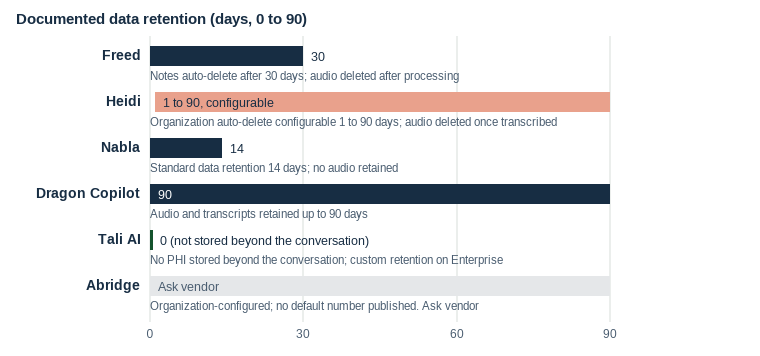
- 2026-10-13: Added At a glance boxes, score breakdowns, Who it is for and Who should skip lists, this change log, a retention chart, an evidence legend, dated vendor page captures and grouped comparison tables. This layout update itself changed no scores or facts.
- 2026-10-13: Heidi pricing updated to the live US pricing page captured 2026-10-13: Free $0; Clinician $110/mo billed annually; Teams custom. The Practice $180/seat plan and Max seat prices no longer appear and were removed.
- 2026-10-13: Heidi model-training item re-scored from 0/5 to 3/5 under the existing rubric (no training on paid plans; de-identified data may be used on the free plan, per the privacy policy). Research score 85 to 88; ranks unchanged.
- 2026-10-12: Rewrote Freed vs Heidi, Heidi vs Nabla, Nabla vs Freed, and Tali vs Freed as in-depth comparisons sourced from official vendor pages; replaced earlier aggregator pricing citations.
- 2026-10-12: Added Abridge vs Dragon Copilot, Freed vs Abridge, and Heidi vs Dragon Copilot comparisons.
- 2026-10-12: Corrected Heidi pricing to the vendor's US page (Clinician $150/mo or $110/mo yearly; Practice $180/seat/mo yearly).
Full history on the corrections page.
Key differences
- Entry price: Heidi has a permanent free plan; Freed starts at $39/mo with a 40-note cap and a 7-day trial.
- Full-featured tier: Freed Premier is $104 to $119/mo; Heidi Clinician is $150/mo or $110/mo billed yearly, with a Max seat at $409/mo or $299/mo billed yearly for 5x Agents usage, and Teams is a custom quote.
- Apps: Heidi has native iOS, Android, macOS, and Windows apps; Freed runs in any browser plus a Zoom app.
- EHRs: Heidi has native athenahealth and Epic (SMART on FHIR) options; Freed pushes to browser-based EHRs on Premier.
- Certifications: Heidi lists ISO 27001 and ISO 42001 in addition to SOC 2 Type II; Freed lists SOC 2 Type 2.
Company background
Freed
Freed was co-founded in January 2023 in San Francisco by Erez Druk and Andrey Bannikov, both former Meta engineers; Druk has said the idea came from watching his physician wife finish notes at night. In March 2025 Freed announced a $30 million Series A led by Sequoia Capital, bringing total funding to about $34 million, and reported more than 17,000 paying clinicians across 96 specialties at the time, with a team of roughly 50 people (CNBC). Freed's own company story page now says 26,000+ clinicians across 1,700+ clinics use the product. Freed sells directly to individual clinicians and small groups with self-serve checkout, and offers a Groups plan for clinics. It has also expanded beyond the scribe into coding, clinical evidence answers, visit prep, and a separate front desk product.
Heidi Health
Heidi was founded in Melbourne, Australia, in 2021 by Dr. Thomas Kelly (a former vascular surgical resident), Waleed Mussa, and Yu Liu, and began launching products in early 2024 (TechCrunch). In October 2025 it closed a $65 million Series B led by Point72 Private Investments at a $465 million valuation, bringing total funding to $96.6 million (Heidi press release). At that time Heidi reported more than 2 million consults a week in 110 languages across 116 countries; its homepage now cites 175M+ patient interactions supported worldwide. Heidi sells both self-serve (Free, Clinician, Teams) and enterprise plans, and lists health system customers such as Beth Israel Lahey Health and MaineGeneral Health on its site.
Side-by-side comparison
Evidence labels used in every table cell
- Documentation reviewedWe read it on the vendor's own page
- Vendor-reportedVendor claim we could not check line by line
- Third-party sourcedFrom a non-vendor source; treat with care
- Ask vendorNot published; ask the vendor in writing
Prices in USD unless noted. "Ask vendor" means the vendor does not publish it. Each cell carries an evidence label; see how we label evidence.
| Feature | Freed | Heidi |
|---|---|---|
| Pricing tiers (exact, as published) | Starter $39/mo (up to 40 notes/mo); Core $79/mo (unlimited notes); Premier $119/mo monthly or $104/mo billed annually; Groups: custom quote Documentation reviewed | Free $0; Clinician $150/mo or $110/mo billed yearly; Max seat $409/mo or $299/mo billed yearly (5x Agents usage); Teams: custom (US pricing page, checked 2026-10-14) Documentation reviewed |
| Free tier / trial | No permanent free plan. 7-day free trial, no credit card. Pricing page offers Core free to residents, students, and trainees. Documentation reviewed | Yes. Free plan with unlimited transcription and standard templates; Ask Heidi and advanced templates limited Documentation reviewed |
| Contract terms | Monthly or annual self-serve; Groups by contract. Minimum term: Ask vendor Documentation reviewed | Monthly or annual self-serve billing; Teams and Enterprise on custom terms Documentation reviewed |
| Data retention and deletion | Audio deleted after the note is processed (recoverable up to 48 hours; troubleshooting copies up to 14 days). Notes deletable anytime or auto-deleted after 30 days (backups up to 7 more days). Custom retention on Groups. Documentation reviewed | Audio deleted once the transcript is created unless you enable a recording-saving feature. Organization auto-deletion configurable from 1 to 90 days; otherwise retained until deleted. Flexible retention on team plans. Documentation reviewed |
| HIPAA BAA (and which plan) | Yes. BAA is Schedule A of the Platform Terms and applies from sign-up on every plan; signed copy on request; organization-wide BAA on Groups Documentation reviewed | Yes. Heidi states it makes a BAA available to every covered entity it works with; the privacy policy (as checked 2026-10-13) says the business associate role can apply to organization, individual self-serve and free accounts Documentation reviewed |
| SOC 2 / ISO / HITRUST | SOC 2 Type 2 (vendor states). ISO 27001 / HITRUST: Ask vendor Vendor-reported | SOC 2 Type II, ISO/IEC 27001:2022, ISO/IEC 42001, Cyber Essentials Plus (privacy policy). HITRUST: Ask vendor Vendor-reported |
| Where data is stored | United States (Microsoft Azure) Documentation reviewed | Regional hosting; US customer data hosted in the United States (also AU, UK, EU, Canada, Switzerland) Documentation reviewed |
| Data used for model training? | Vendor says PHI is never used for training and models are trained only on de-identified notes; Terms also allow training on your data with consent given in Platform settings Vendor-reported | Privacy policy (2026-09-29, as checked 2026-10-13): no customer data or health information is used to train AI models on organization and paid individual plans; on the free plan, de-identified data may be used under the Terms of Service Documentation reviewed |
| Consent features | Sample patient consent script published in FAQ and Help Center; in-app consent capture: Ask vendor Documentation reviewed | Patient consent resources published; in-app consent capture: Ask vendor Documentation reviewed |
| EHR integrations | EHR push to browser-based EHRs on Premier ("send notes straight into any browser-based EHR with one click"); copy and paste on other plans Vendor-reported | Native athenahealth integration (schedule sync, structured writeback); Epic via SMART on FHIR; desktop app integrations; EHR integration is an add-on on some plans Vendor-reported |
| Platforms | Web on any desktop, tablet, or smartphone browser; Zoom app for telehealth. Native app details: Ask vendor Documentation reviewed | Web, iOS, Android, and Heidi Desktop for macOS and Windows Documentation reviewed |
| In-person, telehealth, offline | In-person and telehealth both supported (Zoom app available). Offline recording: Ask vendor Vendor-reported | In-person and telehealth (Desktop captures call audio directly). Offline recording: Ask vendor Vendor-reported |
| Specialties and templates | Specialty-specific templates for 20+ specialties, including psychiatry and mental and behavioral health; personal templates; instant template builder (Core and up) Vendor-reported | Standard templates on Free; advanced templates and team template sharing on paid plans; template configuration 1:1 on higher tiers Vendor-reported |
| Note styles (SOAP/DAP/BIRP) | SOAP shown by default; specialty headers and custom formats. Named DAP/BIRP templates: Ask vendor Vendor-reported | Template library includes SOAP and specialty formats; named DAP/BIRP availability: Ask vendor Vendor-reported |
| Languages | Captures visits in multiple languages and writes the note in English (Spanish, Mandarin, Italian, German, Russian, Japanese, French, Korean, Thai, Portuguese, Dutch, Swedish, Polish, Indonesian listed) Vendor-reported | Vendor reports use in 110 languages (Series B release); research cites transcription across 77 languages Vendor-reported |
| Editing and customization | Edit notes, "learn my format" from an edited note, dictation and saved phrases (Premier), custom templates Vendor-reported | Template editor, word library, auto-edit rules, and "note insights" that propose fixes from your edits Vendor-reported |
| Coding and billing help | Coding Assistant with ICD-10, E/M, and CPT suggestions on Premier Vendor-reported | Coding listed as a paid-plan feature on the pricing grid Vendor-reported |
| Patient instructions and letters | Patient instructions, referral letters, and exception notes on Premier Vendor-reported | Drafts referrals, letters, care plans, and patient recaps from the note; recaps wait for clinician approval Vendor-reported |
| Support | Live support from a Clinician Success team; dedicated account manager on Groups Vendor-reported | Priority support, guided onboarding, and dedicated customer success on higher tiers Vendor-reported |
Workflow walkthrough
Freed
A typical Freed visit starts in the browser or on a phone: start a recording, see the patient, stop, and a draft note appears in about a minute. You review it against the transcript (available at the bottom of each note), edit, and either copy it into your EHR or, on Premier, push it into a browser-based EHR. Telehealth visits can be captured with the Zoom app. The workflow is deliberately simple and self-serve; there is little IT setup, which is the main reason solo clinicians adopt it quickly.
Heidi
With Heidi you open a session (on web, phone, or the desktop app), record or dictate, and a note is generated from the template you pick. The desktop app can dictate into any window and capture telehealth audio without a second login. After the visit Heidi can draft follow-on documents such as referral letters, care plans, and patient recaps, and its newer agent features can prep charts before clinic. Notes reach the EHR by copy and paste, by the athenahealth or Epic integrations, or through desktop app integrations, depending on plan.
Psychiatry and behavioral health fit
Two federal rules matter for behavioral health. HIPAA treats psychotherapy notes (kept separate from the medical record) as a special category, so check that a scribe's default note does not blend process notes into the chart. Federally assisted substance use disorder programs are also covered by 42 CFR Part 2; the 2024 final rule aligned Part 2 more closely with HIPAA, with a compliance date of February 16, 2026 (HHS). None of the vendors here publicly describe Part 2 specific controls, The rule states that segregating Part 2 records is not required, and it creates a new category of SUD counseling notes that need separate patient consent, much like HIPAA psychotherapy notes. Part 2 programs should get written answers on how each tool handles consent, counseling-note content, and redisclosure before use.
Freed
Freed lists psychiatry and mental and behavioral health among its specialty templates, and its blog and Help Center publish behavioral health note guidance. For therapy-heavy practices, check whether the default structure separates the progress note from anything you would treat as HIPAA psychotherapy notes, and confirm you can suppress sensitive details (trauma narratives, substance use, third-party information) before notes leave the tool. The 30-day auto-delete option and default audio deletion help minimize retained sensitive content. Freed does not publicly describe 42 CFR Part 2 specific controls: Ask vendor.
Heidi
Heidi publishes progress note resources on its site (psychiatry-specific templates: Ask vendor), and its configurable retention (1 to 90 day auto-delete for organizations) and default audio deletion suit practices that want short retention of sensitive material. Because Heidi increasingly drafts patient-facing recaps and runs agents over chart data, behavioral health practices should decide which outputs are allowed for sensitive visits and keep patient recaps behind clinician approval (which Heidi says is the default). Heidi does not publicly describe 42 CFR Part 2 specific controls: Ask vendor.
Strengths and weaknesses
Freed
Strengths
- Lowest published entry price in this group ($39/mo Starter)
- Transparent public pricing and self-serve signup
- BAA included in Terms on every plan, including the trial
- Psychiatry and behavioral health templates listed
- Default audio deletion plus optional 30-day note auto-delete
Weaknesses
- No permanent free plan (7-day trial only)
- EHR push, coding, and letters require Premier ($104 to $119/mo)
- Starter caps at 40 notes a month
- Note-level integrations are browser-based; deep Epic workflows are not its focus
- ISO 27001 or HITRUST not publicly listed
Heidi
Strengths
- Real free plan with unlimited transcription
- Native apps on web, iOS, Android, macOS, and Windows
- Broad certifications (SOC 2 Type II, ISO 27001, ISO 42001)
- Strong multilingual reach
- Letters, recaps, and agents beyond the note
Weaknesses
- Clinician plan ($110/mo billed yearly, $150/mo monthly) costs more than Freed Core ($79/mo)
- Team pricing is a custom quote, not published
- EHR integration is an add-on on some plans
- Free plan: de-identified data may be used for model training under the Terms of Service
- Feature set is broad and changes quickly, which can mean more setup
Who each is for and who should skip it
Freed
Who Freed is for
- Solo outpatient psychiatrist or PMHNP who wants to buy today: Starter is $39/mo with a 7-day trial, and the BAA is part of the Platform Terms on every plan.
- Psychiatrist or therapist on a browser-based EHR: Premier can push notes into browser-based EHRs.
- Telehealth-heavy practice: captures browser-tab telehealth (Zoom web, Google Meet, Teams web, Doxy.me) and offers a Zoom app.
- Clinician who wants short retention: audio is deleted after processing and notes can auto-delete after 30 days.
Who should skip Freed
- Practice on Epic or athenahealth that needs in-chart writeback: no Epic or other named native integration is publicly documented.
- 42 CFR Part 2 program: Part 2 specific controls are not publicly documented. Ask vendor.
- Clinician who wants a permanent free plan: Freed offers a 7-day trial, not a free plan.
- Group practice that wants a published group price: Groups is a custom quote.
Heidi
Who Heidi is for
- Solo psychiatrist on athenahealth: a native athenahealth integration with schedule sync and structured writeback is listed.
- Clinician who wants to start free: the Free plan includes unlimited transcription.
- Group practice that wants one BAA: Heidi says it makes a BAA available to every covered entity, and organizations can set auto-delete from 1 to 90 days.
- Psychiatry service on Epic: Epic via SMART on FHIR is listed.
Who should skip Heidi
- 42 CFR Part 2 program: Part 2 specific controls are not publicly described. Ask vendor.
- Free-plan user who does not want de-identified data used for model training: the Terms allow it on the free plan.
- Buyer who wants the lowest paid price: Clinician is $110/mo billed yearly ($150/mo monthly), above Freed Core at $79/mo.
- Group practice that wants a published team price: Teams is a custom quote.
Who should pick which
| Practice type | Better fit |
|---|---|
| Solo psychiatrist, mostly med management, tight budget | Freed Starter or Core if volume is under or over 40 notes a month; Heidi Free if you want to start at $0 |
| Therapy-heavy practice wanting short retention | Either; Freed's 30-day auto-delete or Heidi's 1 to 90 day organization auto-delete |
| athenahealth or Epic users | Heidi, given native integration options |
| Clinicians who want coding plus letters in one plan | Freed Premier |
| Multilingual practice | Heidi, given broader stated language coverage |
Verdict
Pick Freed for the simplest workflow and lowest published paid entry ($39/mo), with BAA coverage from day one. Pick Heidi if you want a free plan, native apps, or athenahealth/Epic integration, and can accept higher paid tiers.
Whichever you choose, sign the BAA before any real patient audio is recorded, set retention to the shortest period that fits your workflow, and test with your own templates during the trial or pilot.
Visit Freed pricing (source)May earn a referral fee. No paid placement.
Visit Heidi pricing (source)May earn a referral fee. No paid placement.
Related reading: Freed review, Heidi review and the psychiatry AI scribe guide.
FAQ
Is Freed or Heidi cheaper?
At $0, Heidi's free plan is cheapest. Among paid plans, Freed Starter ($39/mo) and Core ($79/mo) are lower than Heidi Clinician ($110/mo billed yearly or $150/mo monthly).
Do both sign a BAA?
Freed includes its BAA in its Terms for every account and provides a signed copy on request. Heidi states a BAA is available to every covered entity; confirm whether that includes the Free plan.
Which keeps less data?
Both delete audio after processing by default. Freed offers 30-day note auto-deletion; Heidi organizations can set 1 to 90 days.
Is this medical or legal advice?
No. This is general information. Confirm BAA terms, data use, and consent requirements with each vendor and your compliance advisor before using patient data.
How were facts checked?
Each fact comes from the vendor's official pricing, security, trust, or help pages, checked on 2026-11-06. Where a vendor does not publish something, we say so rather than estimate it.
Sources and last checked
All links checked 2026-11-06. Vendors change prices and terms often; re-verify before buying.
- Freed pricing (checked 2026-10-12)
- Freed security (checked 2026-10-12)
- Freed BAA help article (checked 2026-10-12)
- Freed privacy and audio retention (checked 2026-10-12)
- Freed Platform Terms of Use (checked 2026-10-12)
- Freed Series A press release (checked 2026-10-12)
- Heidi pricing (US) (checked 2026-10-14)
- Heidi HIPAA and BAA (checked 2026-10-12)
- Heidi privacy policy (certifications, retention) (checked 2026-10-12)
- Heidi Trust Centre (checked 2026-10-12)
- Heidi Series B announcement (checked 2026-10-12)
- HHS, 42 CFR Part 2 final rule fact sheet (checked 2026-10-12)